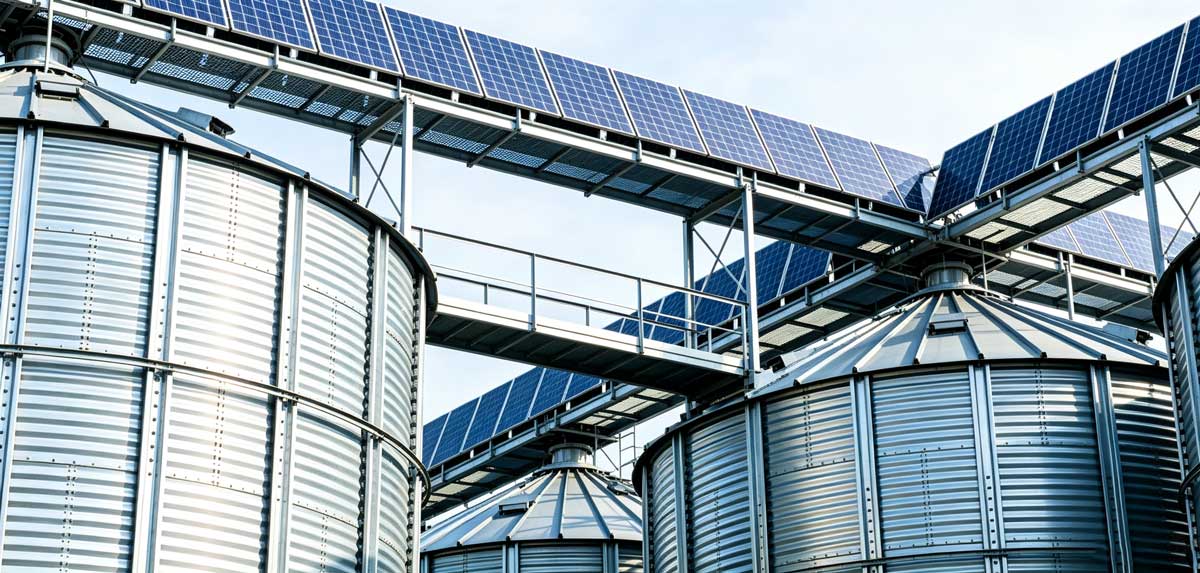
Third, it provides physical cooling and auxiliary protection. PV modules covering the roof and walls create a physical shading layer that effectively lowers internal temperatures, thereby reducing the risk of grain spoilage due to mold during the summer. Additionally, this coverage acts like a "sun-protective layer" for the silo roof, helping to slow the aging of the waterproofing membrane.
Technical Architecture: Five Core Modules
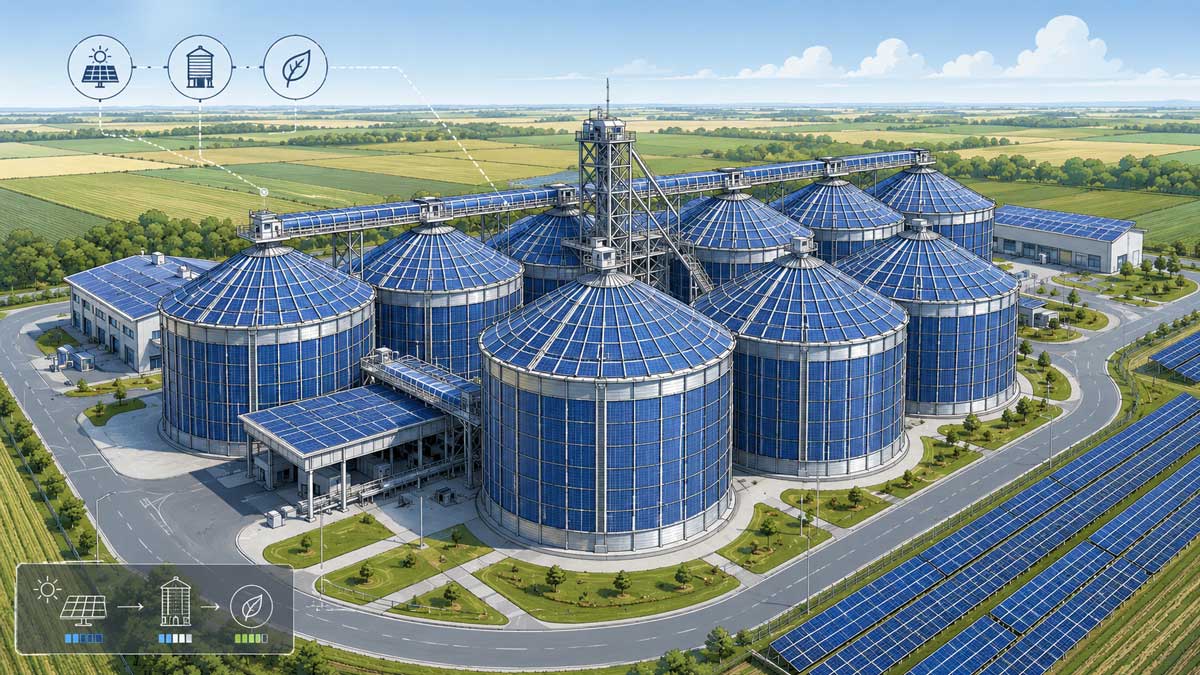
A complete photovoltaic (PV) microgrid system for steel silos generally consists of the following five components:
| Module |
Core Components |
Primary Function |
| PV Power Generation |
PV modules (flexible/rigid), mounting structures |
Generates power using unused surface areas on silo roofs, walls, and walkways |
| Energy Storage System |
Modular lithium battery storage cabinets, Power Conversion System (PCS) |
Stores excess energy, enables peak-valley arbitrage, provides emergency backup power |
| Inverter and Power Distribution |
String inverters, low-voltage distribution cabinets, lightning/surge protection |
Converts DC to AC, performs Maximum Power Point Tracking (MPPT), and handles power collection, metering, and safety protection |
| Microgrid Control |
Microgrid controller, Automatic Transfer Switch (ATS) |
Manages grid-tied/off-grid mode switching and intelligent dispatching |
| O&M Monitoring |
Cloud platform, mobile app |
Remote monitoring and alerts for power generation, energy storage, load, and environmental data inside the silo |
1. Photovoltaic (PV) Generation Component
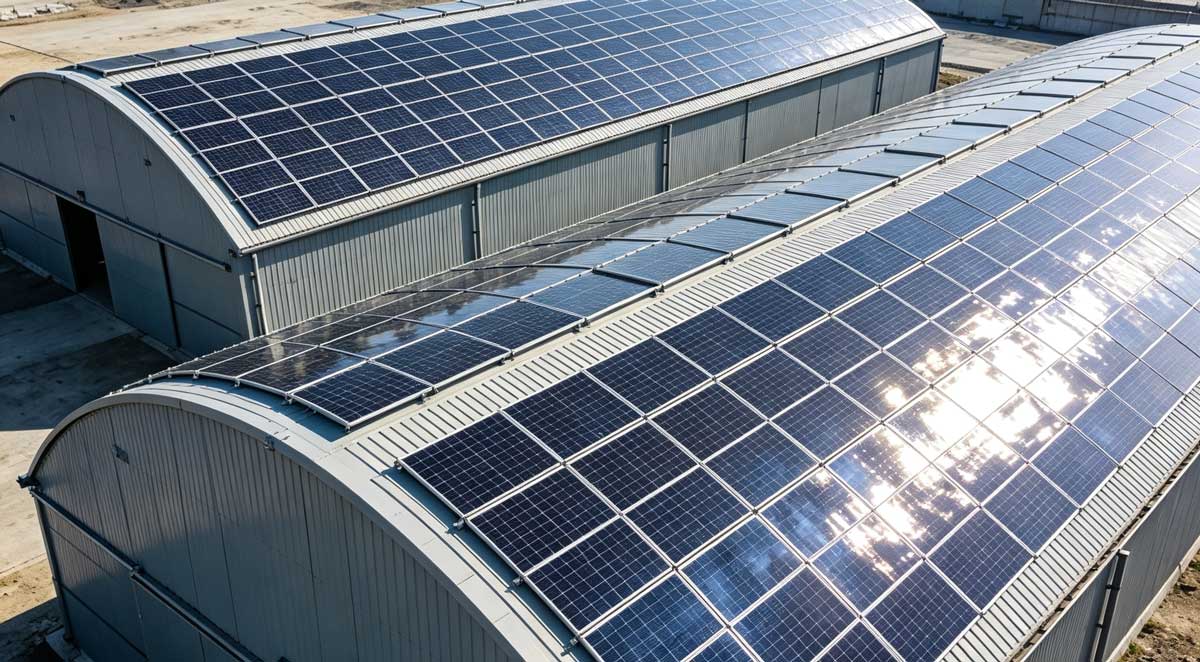
Depending on the steel silo's configuration, lightweight flexible modules can be conform to the curved silo walls, while traditional rigid modules are installed on the silo roof and walkways. Flexible modules are lightweight and conform well to curved surfaces, whereas rigid modules offer high efficiency and low cost, making them suitable for flat surfaces.
2. Energy Storage System Component
Modular lithium-ion energy storage cabinets are deployed in unused spaces around the silo perimeter. The energy storage system serves three purposes: storing excess daytime power to prevent curtailment, performing peak-valley arbitrage to reduce electricity costs, and acting as an emergency power source during outages. A Power Conversion System (PCS) manages charging and discharging while balancing PV generation with load demand.
3. Inverter and Power Distribution Component
String inverters convert DC power from the PV arrays into AC power and perform Maximum Power Point Tracking (MPPT). Low-voltage distribution cabinets, lightning/ surge protection devices, and switch gear handle power aggregation, metering, and safety protection. The entire system features anti-back flow, anti-islanding, and over/ under-voltage protection capabilities.
4. Microgrid Control Component
The microgrid controller acts as the system's "brain," flexibly switching between grid-tied and off-grid modes to enable intelligent scheduling: self-generation and self-consumption, storing excess power, discharging when power is needed, and feeding surplus power back to the grid. An Automatic Transfer Switch (ATS) ensures uninterrupted power supply during mode transitions.
5. O&M and Monitoring Component
A cloud platform combined with a mobile app collects real-time data—such as power generation, energy storage status, electrical loads, and internal silo temperature/ humidity—enabling remote monitoring, fault alarms, and maintenance alerts without the need for on-site personnel. Crucially, the system can interface with the grain depot's information system and smart warehouse management system, creating an integrated solution that links PV generation, energy storage, and grain storage safety.
In SRON's bulk material storage and transport EPC projects, centralized control, IoT monitoring, and smart warehouse management are already standard features. Operational data from the PV microgrid can be fully integrated into the same platform, providing a clear, comprehensive overview of power generation, energy storage, consumption, and warehouse operations.
The Economics: How to Assess the Return on Investment ?
The return on investment for a photovoltaic (PV) microgrid hinges on three core variables: local electricity prices, solar resources, and the usable installation area on the storage structures. Whether on silo walls, conveyor gallery roofs, or the tops of bulk material storage yards, installing PV modules on these otherwise idle surfaces allows solar energy to be continuously converted into electricity cost savings.
Industry data indicates that the financial case is strongest in markets with abundant solar resources and high electricity prices. While PV systems typically have a design lifespan of 25 years, the payback period depends on local electricity rates, solar irradiance, load profiles, and government policies, requiring project-specific calculations; returns can be further enhanced in regions featuring peak-valley tariff differentials, carbon trading, or green electricity trading mechanisms.
The economic benefits are particularly compelling in overseas markets—such as the Middle East and Africa—characterized by high electricity prices and excellent solar resources. Taking the Cairo region of Egypt as an example (based on external industry estimates): with approximately 2,270 peak sun hours per year, installing PV modules on a 240-degree arc of the silo wall yields an annual generation of roughly 148,000 kWh, resulting in an estimated payback period of about 5.8 years. Given that local industrial electricity costs range from approximately $0.07 to $0.11 per kWh—and with a clear upward trend in electricity prices—the potential for actual returns may be even higher.
From Energy Consumer to Energy Producer: A Fundamental Shift in the Role of Steel Silos
Traditional steel silos are merely passive storage facilities that consume electricity, rely on the grid, and result in carbon emissions. In contrast, the "steel silo plus photovoltaic (PV) microgrid" solution transforms the silo from an energy-consuming unit into an energy-generating one.
This represents not just an equipment upgrade, but a restructuring of the business model. Underutilized silo roofs and walls become power-generating assets; electricity expenses turn into revenue from power generation; and the burden of carbon emissions transforms into carbon assets. For export-oriented enterprises, the use of green electricity also helps improve ESG ratings and enhances international competitiveness.
Looking further ahead, multiple steel silo PV microgrids can be coordinated to form an interconnected, cross-regional energy network. Deep integration between the microgrid system and the silo’s intelligent control mechanisms enables a unified, smart storage-and-grid ecosystem. The steel silo ceases to be an isolated storage node and instead becomes an intelligent node within a green energy network.
The green transformation of the bulk material storage and logistics industry does not require starting from scratch. Silo roofs and walls are, in fact, overlooked energy goldmines. Photovoltaic microgrids serve to awaken these dormant resources, turning every steel silo into a small-scale green power plant. This makes sense both in the immediate term—adding a layer of emergency security for grain storage—and for the long-term future: in the era of China's "Dual Carbon" goals, green power generation capability is becoming a core competency for bulk storage and logistics enterprises. If you are planning the construction of new steel silos or a green, low-carbon retrofit, we invite you to consult the SRON Engineering team; we can analyze the specific conditions of your project and help you calculate the benefits.
FAQs
Q1: Will installing photovoltaic (PV) modules on the roof or walls of a steel silo compromise the structural integrity of the silo?
Specialized assessments—covering structural load-bearing capacity, wind loads, lightning protection, and electrical safety—must be completed and verified by the engineering design team before installation; only silos meeting the necessary criteria may proceed. This is also why PV microgrid solutions undergo project-specific reviews.
Q2: Can the system ensure continuous grain condition monitoring during a grid power outage?
With the inclusion of energy storage batteries and a microgrid controller, the system can switch to "islanded" operation mode during grid outages, maintaining power supply to critical loads such as temperature monitoring, ventilation, and surveillance systems. Actual switching capabilities and the duration of supported operation depend on the specific system configuration.
Q3: What is the typical payback period for a steel silo PV microgrid?
It depends primarily on local electricity prices, solar resources, and load characteristics. In markets with abundant solar resources and high electricity prices—such as the Middle East and Africa—industry estimates place the payback period at around 5 to 6 years (e.g., an estimated 5.8 years for the Cairo region). Specific projects require calculations based on local conditions.
Q4: Will PV modules accelerate the aging of the silo roof?
Quite the opposite; the PV modules act as a shading and external protective layer, slowing down the aging of the roof materials. However, it is important to note that PV modules cannot replace the silo's thermal insulation, waterproofing, or anti-corrosion designs.
Q5: Does SRON offer PV microgrid solutions for steel silos?
PV energy storage microgrids represent a low-carbon initiative that SRON is actively researching and advancing; these systems can be integrated with smart warehouse management systems. Technical specifications and implementation conditions for specific solutions are determined following a project-specific review.