Why Are More Industrial Bulk Storage Projects Choosing Pneumatic Conveying Systems?

May 29, 2026Keywords: pneumatic conveying system,industrial bulk material conveying ,industrial bulk storage system

As industrial warehousing projects continue to evolve towards larger scale, environmental friendliness, and automation, enterprises are placing higher demands on the airtightness, stability, conveying efficiency, and intelligent control capabilities of material conveying systems. For powdery or easily dusty materials such as cement, fly ash, mineral powder, and lime powder, traditional mechanical conveying methods may face challenges in dust control, spatial arrangement, long-distance conveying, and system coordination under certain operating conditions.

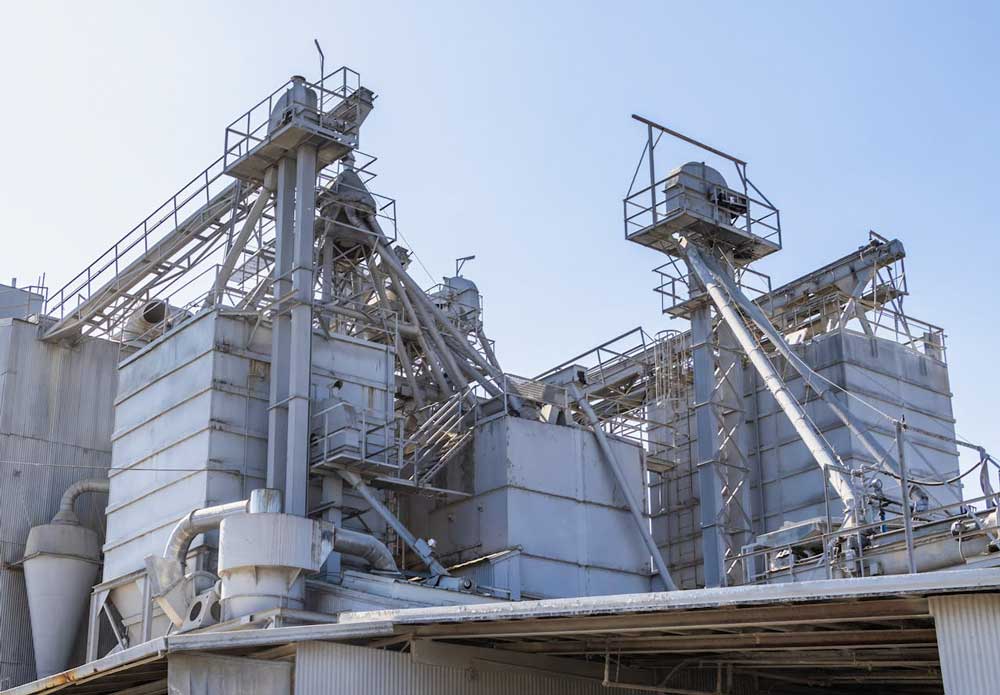
Against this backdrop, pneumatic conveying systems, with their advantages of airtight conveying, flexible layout, high degree of automation, and suitability for powdery and easily dusty materials, are increasingly being used in industrial warehousing projects. Especially in steel silo supporting projects, pneumatic conveying systems are no longer just single conveying equipment, but also an important component for achieving efficient silo loading, stable discharge, environmentally friendly operation, and intelligent management. SRON's existing industrial system capabilities also cover complete solutions including silo systems, pneumatic conveying systems, dynamic metering systems, intelligent control systems, and rapid loading systems.


What is a pneumatic conveying system?

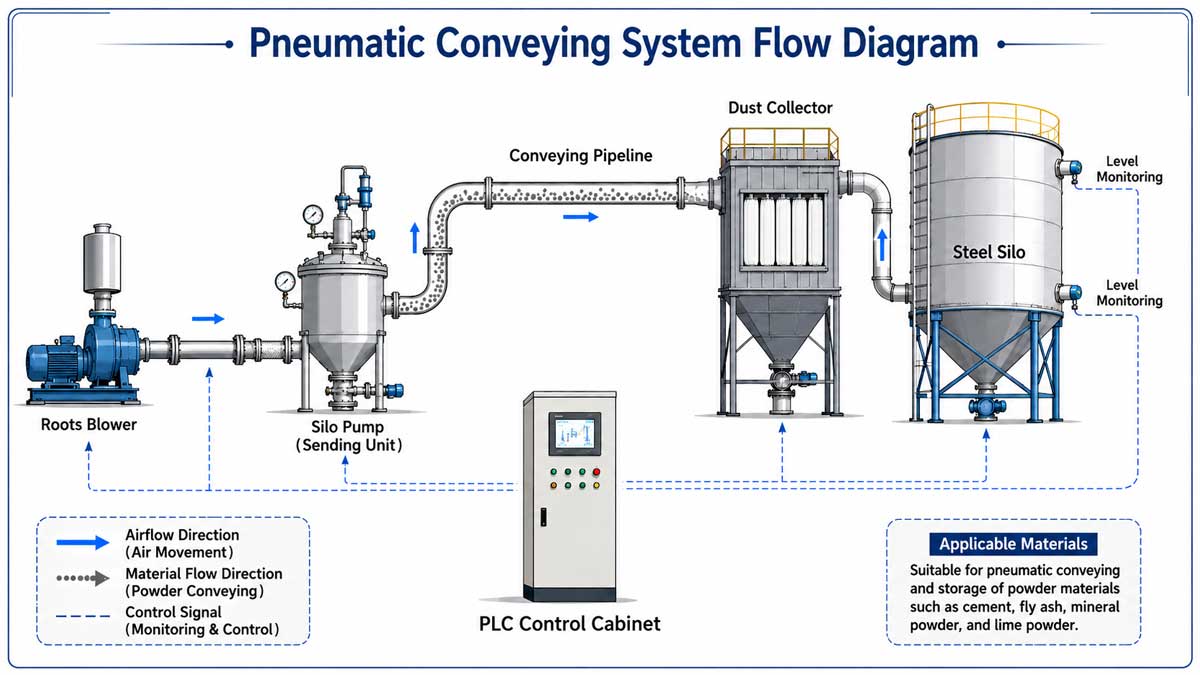
A pneumatic conveying system uses airflow as the conveying power to transport powdery or granular materials through closed pipelines. Depending on the material characteristics, conveying distance, and process requirements, different positive pressure, negative pressure, or dense phase conveying methods can be employed. In industrial warehousing projects, pneumatic conveying is commonly used for material receiving, bottom discharge, inter-warehouse transfer, loading, and batching.

Compared to traditional belt conveyors and screw conveyors, pneumatic conveying systems have the following characteristics:
Fully enclosed conveying process
Low dust pollution
High degree of automation
Small footprint
Long conveying distance
Suitable for complex working conditions

Therefore, in modern industrial warehousing, pneumatic conveying systems have become an important solution for powder conveying.


Why are industrial warehousing increasingly choosing pneumatic conveying systems?

1. Outstanding Environmental Performance

Traditional conveying equipment easily generates dust during operation, affecting the production environment and potentially causing material waste. Pneumatic conveying systems, using a fully enclosed conveying method, effectively reduce dust leakage, meeting modern environmental protection requirements.

For the cement industry, dust control has always been a key focus. Using cement pneumatic conveying systems can significantly reduce dust concentration in the workshop, improving the quality of the production environment.

2. High Degree of Automation

Modern industrial warehousing increasingly emphasizes intelligent management. Pneumatic conveying systems can be integrated with PLC automatic control systems to achieve: automatic feeding, automatic unloading, automatic metering, remote monitoring, and intelligent alarms. Especially in large steel silo projects, automated conveying not only reduces labor costs but also improves overall warehousing operational efficiency.

3. High Conveying Efficiency

Pneumatic conveying systems can achieve horizontal, vertical, and long-distance conveying, offering significant advantages for complex plant layouts. For example, in large cement plants, materials often need to be directly conveyed from the production line to steel silos for storage. Adopting a pneumatic conveying system for steel silos can effectively reduce intermediate transfer links and improve overall production efficiency.

4. Flexible Equipment Layout

Traditional mechanical conveying equipment requires significant installation space, while pneumatic conveying systems, primarily relying on pipeline transport, can be flexibly arranged according to the factory structure. This is a clear advantage for industrial warehousing projects with limited space.


Which industrial projects are best suited for pneumatic conveying systems?

Not all industrial material handling projects are suitable for the same conveying method. However, pneumatic conveying systems are generally highly adaptable to the following scenarios:

1. Cement and Grinding Projects
In cement production, grinding, and storage projects, materials generate significant dust and are transported frequently, requiring high levels of airtightness and continuity. Pneumatic conveying systems can be applied to cement silo entry, bottom discharge, bulk loading, and process line transfer.

2. Fly Ash Storage and Shipping Projects
Fly ash is a typical fine powder material, prone to dust generation, requiring high environmental protection and conveying stability. Pneumatic conveying systems better meet its needs for airtight and long-distance transport, suitable for power plant ash silos, fly ash steel silos, and shipping systems.

3. Projects involving easily dusty powders such as mineral powder and lime powder
Material powder and lime powder are prone to dust generation and loss during transport. Using pneumatic conveying systems helps improve the plant environment and enhances the overall coordination of storage and conveying systems.

4. Steel Silo Supporting Inbound, Outbound, and Loading Systems
In industrial steel silo projects, pneumatic conveying systems are often used in conjunction with silo body, bottom unloading, dust removal, metering, and loading systems. For projects requiring continuous operation, automatic control, and environmental compliance, this type of system combination has strong engineering application value. SRON's industrial brochure also lists pneumatic conveying systems as an important component of industrial bulk material storage and transportation systems, and configures them in synergy with unloading systems, metering systems, control systems, and rapid loading systems.


What are the benefits of using pneumatic conveying systems in steel silo projects?

Steel silos are widely used in industrial projects such as cement, fly ash, mineral powder, power, and chemicals due to their large storage capacity, high space utilization, short construction period, and suitability for storing large bulk materials. For steel silo systems, the configuration level of the conveying system directly affects the silo's operational efficiency and the overall project performance.

Main advantages of pneumatic conveying systems for steel silos:

 
1. Facilitates efficient silo loading

Through pneumatic conveying, materials can be directly transported to the silo body along closed pipelines, reducing intermediate transfer links, improving loading efficiency, and reducing the risk of dust and spillage.

2. Improves the stability of discharge and transfer

In steel silo systems, the stability of bottom discharge and subsequent conveying is crucial. Pneumatic conveying systems can be used in conjunction with bottom aeration and discharge devices to help achieve more stable continuous conveying.

3. Promotes environmental protection and cleaner production

Steel silo projects typically have high requirements for dust control within the plant area. Pneumatic conveying systems utilize a closed-loop method for transporting materials, making them more compatible with dust removal systems, reducing dust dispersion, and improving the production environment.

4. Facilitates Systematized and Automated Management

In modern industrial warehousing engineering, optimizing a single piece of equipment is increasingly limited; companies are focusing more on the overall system's efficiency. When pneumatic conveying systems are designed in conjunction with steel silos, dust removal, metering, level monitoring, and centralized control systems, they further enhance the overall automation level and management efficiency of the project. SRON documentation explicitly identifies pneumatic conveying, dynamic metering, intelligent control, and rapid loading as crucial components of bulk material storage and transportation systems.


Future Development Trends of Pneumatic Conveying Systems

With the continuous advancement of industrial intelligence and environmental protection policies, pneumatic conveying systems will develop in the following directions in the future:

1. Intelligent Control
Combining IoT and industrial automation technologies to achieve remote monitoring and intelligent operation and maintenance.

2. Energy-Saving Design
Reducing system energy consumption through optimized airflow control and equipment structure.

3. Large-Scale Development
Meeting the high conveying capacity demands of large steel silos and modern factories.

4. Environmental Performance Upgrades
Further reducing dust emissions to achieve green production.


The increasing prevalence of pneumatic conveying systems in industrial warehousing projects in recent years is no accident. For powdery or easily dusty materials such as cement, fly ash, mineral powder, and lime powder, companies are now focusing not only on "whether it can be conveyed," but also on whether the conveying process can effectively manage environmental protection, material loss, automation, and on-site management.

Especially in steel silo projects, pneumatic conveying systems are no longer just standalone equipment, but a crucial component of the overall warehousing operation. For owners, choosing a pneumatic conveying system is not simply selecting a conveying method, but rather preparing for future operational efficiency, environmental performance, and ease of management.

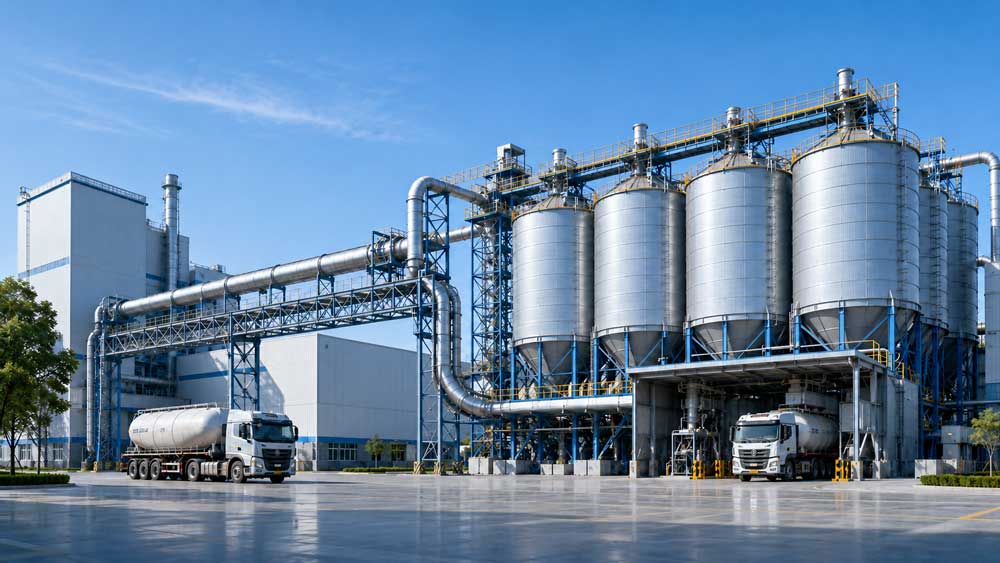
We can provide free customized storage and transportation solutions according to your storage needs and site conditions.

Contact US Now!